For adults with a narrow upper jaw, palatal expansion can dramatically improve both dental function and airway health. Because the palatal suture fuses in adulthood, traditional tooth-borne expanders used in children are ineffective. Instead, adults typically choose between MARPE and SARPE.
What Is It?
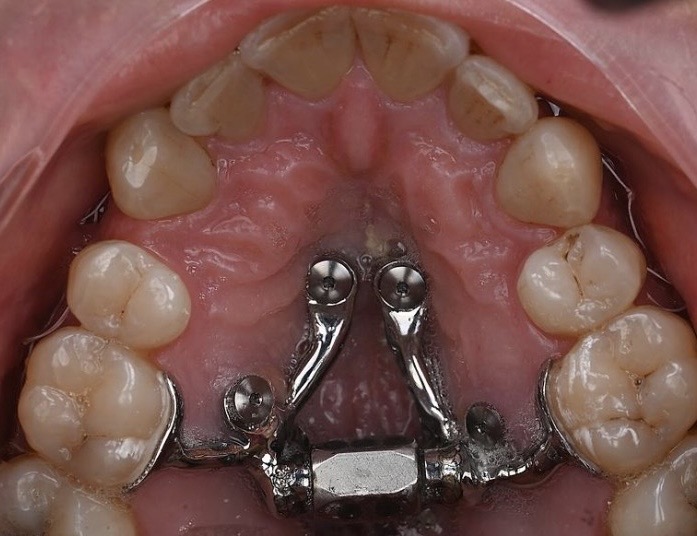
MARPE (Miniscrew-Assisted Rapid Palatal Expansion) uses 4 to 6 temporary titanium miniscrews placed in the roof of the mouth to anchor the expander directly to the bone. SARPE (Surgically Assisted Rapid Palatal Expansion) involves an oral surgeon making cuts in the jawbone to separate the palate before an expander is used.
Why Does It Matter?
Choosing between a minimally invasive clinical procedure (MARPE) and a major surgery (SARPE) is a significant decision. Understanding the differences helps patients make informed choices about their care and recovery.
Diagnosis & Assessment
We use CBCT 3D imaging to assess the density of the midpalatal suture and the surrounding bone to determine if MARPE is likely to be successful.
Benefits
- MARPE: No hospital stay, lower cost, faster recovery, less risk of nerve damage.
- SARPE: Guaranteed separation of the maxilla, effective even in older patients with dense bone.
MARPE: The Minimally Invasive Approach
MARPE is performed in the dental chair under local anaesthetic. The miniscrews distribute the expansion force directly to the bone, splitting the suture without the need for surgical cuts. Recovery is typically fast, with mild discomfort lasting only a few days.
SARPE: The Surgical Approach
SARPE is performed in a hospital under general anaesthetic. The surgeon surgically releases the maxilla (upper jaw) from its surrounding bones. Recovery takes several weeks and involves significant swelling and dietary restrictions.
Which is better?
At ASURA, we prefer MARPE whenever clinically possible because it avoids the risks, costs, and downtime of major surgery. However, in patients with exceptionally thick or fused bone (often older adults), the suture may not open with MARPE alone, making SARPE necessary.